1948 Tucker Torpedo

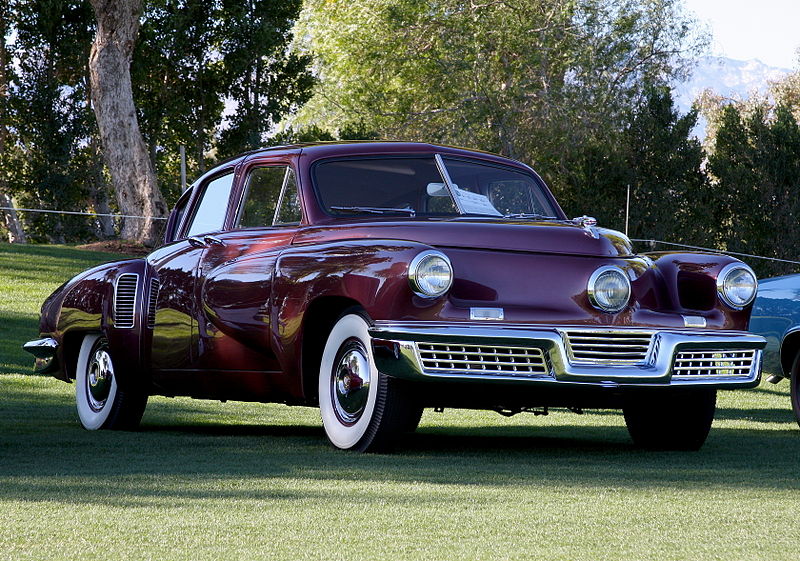
The brainchild of Preston Tucker, the “Torpedo” or Tucker Sedan, was created in response to the lack of new ideas from any of the big three in the early 1940’s. Originally designed with such innovations as four-wheel independent suspension, a rear mounted flat six aluminum engine a hydraulic drive system and four-wheel disc brakes. Sadly only 51 cars were made and the Tucker Torpedo never got out of the starting gates, supposedly due to a conspiracy by the big three. On the bright side, a single iteration of this pioneering automobile is worth a sweet $1.2 million.
The Tucker 48 (named after its model year) is an automobile conceived by Preston Tucker and briefly produced in Chicago in 1948. Only 51 cars were made before the company folded on March 3, 1949, due to negative publicity initiated by the news media, a Securities and Exchange Commission investigation and a heavily publicized stock fraud trial (in which allegations were proven baseless in court with a full acquittal). Speculation exists that the Big Three automakers and Michigan senator Homer S. Ferguson also had a role in the Tucker Corporation's demise. The 1988 movie Tucker: The Man and His Dream is based on the saga surrounding the car's production. The film's director, Francis Ford Coppola, is a Tucker owner and displays his vehicle on the grounds of his winery. The 48's original proposed price was said to be $1,000, but the actual selling price was closer to $4,000. A 1948 Tucker sedan was featured in the July 26, 2011, installment of NBC's It's Worth What? television show. The car's estimated value at that time was US$1,200,000. The car is commonly referred to as the "Tucker Torpedo". This name was never used in conjunction with the actual production car, and its name was officially "Tucker 48".
After World War II, the public was ready for totally new car designs, but the Big Three Detroit automakers had not developed any new models since 1941. This provided great opportunities for new, small automakers, which could develop new cars more rapidly than the huge legacy automakers. Studebaker was the first to introduce an all-new postwar model, but Tucker took a different track, designing a safety car with innovative features and modern styling. His specifications called for a water-cooled aluminum block flat-6 rear engine, disc brakes, four-wheel independent suspension, fuel injection, the location of all instruments within reach of the steering wheel, seat belts, and a padded dashboard.
Even before the war's end, Preston Tucker began working on plans for his new automobile. In the summer of 1944, he hired noted car designer George S. Lawson to style his new automobile. Lawson worked on the project for over a year and a half before his design debuted publicly, beginning about February 1946 and found as late as a year later in March 1947. Lawson was named the Tucker Corporation's "chief stylist" in February 1946, immediately upon the company's formation.

In December 1946, Lawson resigned from the company after a disagreement with Preston Tucker, and shortly thereafter, now-famous stylist Alex Tremulis of local Chicago design firm Tammen & Denison, was hired and furthered the development of the Lawson design. Tucker gave Tammen & Denison and Tremulis a three-month contract, which expired in March 1947 and was not renewed. The culmination of Tremulis' efforts during this phase of design development was featured in a full-page advertisement run in numerous national newspapers in March 1947. Tremulis' design was based directly upon the work of George Lawson, but incorporated his own artistic flair.
Simultaneous with Tremulis' departure, Preston Tucker hired a team of five designers (Read Viemeister, Budd Steinhilber, Tucker Madawick, Hal Bergstrom and Phillip Egan) from the New York design firm J. Gordon Lippincott, who updated Tremulis' design just as Tremulis had done with Lawson's.[9] After a month's absence, Tremulis was rehired and the two independent design groups developed full-size clay models side by side in direct competition. Surviving photographs of the two models reveal that Tremulis' clay design remained unchanged from his March 1947 advertisement proposal and was not chosen for production. The passenger side of the Lippincott team's clay model (they submitted two designs), which incorporated the side profile developed by Tremulis prior to their arrival, was chosen virtually intact for the production automobile's styling.
The Tucker '48's evolving appearance in the company's press releases and other promotional materials, combined with suggestive statements such as "15 years of testing produced the car of the year"—despite no running prototype existing at the time—were instrumental in the SEC filing mail and conspiracy fraud charges against Preston Tucker. The SEC, however, failed to prove its case, and Tucker was acquitted of all charges in January 1950. However, the company never recovered.
Tremulis, like George Lawson, was eventually named the Tucker Corporation's "chief stylist," although the first reference to him holding this position does not appear until 1948, after the Tucker '48's exterior styling was completed.
The Tucker automobile was originally named the "Torpedo," but was changed to "Tucker '48" around the time of Lawson's departure and Tremulis' arrival, reportedly because Tucker did not want to remind the public of the horrors of World War II. Alex Tremulis has claimed responsibility for dubbing the first prototype automobile the "Tin Goose," which is presently used in a loving manner but at the time was considered derogatory.
Tucker had promised 150 hp (110 kW; 150 PS), but his innovative engine was not working out. The valve train proved problematic and the engine only produced approximately 88 hp (66 kW). The high oil pressure required a 24-volt electrical system, up to 60 volts to get it started, and a long cranking time at start-up. Additionally, the oil pressure required to maintain valve function was not achieved until the engine was turning at higher RPMs and Tucker's engineers struggled with keeping the valve train working at idle and lower speeds/RPMs. Having wasted nearly a year trying to make the 589 work, Tucker started looking for alternatives.
The company first tried the Lycoming aircraft engine, but it would not fit in the car's rear engine compartment.
 An air-cooled flat-6 engine, the O-335 made by Air Cooled Motors (and originally intended for the Bell 47), fit, and its 166 hp (124 kW; 168 PS) pleased Tucker. He purchased four samples for $5,000 each, and his engineers converted the 334 cubic inches (5,470 cc) engine to water cooling (a decision that has puzzled historians ever since). The Franklin engine was heavily modified by Tucker's engineers, including Eddie Offutt and Tucker's son Preston, Jr. at his Ypsilanti machine shop. Using an aircraft engine in an automotive application required significant modification; thus, very few parts of the original Franklin engine were retained in the final Tucker engine. This durable modification of the engine was tested at maximum power for 150 hours, the equivalent of 18,000 miles (29,000 km), at full throttle.
Tucker quickly bought Air Cooled Motors for $1.8 million to secure the engine source, then canceled all of the company's aircraft contracts so its resources could be focused on making automotive engines. This was a significant decision, since at the time of Tucker's purchase, Franklin held over 65% of post-war U.S. aviation engine production contracts. The loss of income was substantial.
Source:Wikipedia

0 comments