1963 Chevrolet Corvette Sting Ray Coupe


Also known as the C2, this version of the Corvette turned things around for Chevy. Redesigned completely, it sported a now much sought after split window, Corvette-only reverse flip-up headlights, improved handling and performance and a gorgeous silhouette made the C2 a standout amongst American sports cars. Produced for 20 years, the Sting Ray Coupe is as American as it gets. Part elegance and all sinew, the wide and sleek C2 will forever be associated with brilliant American design.
he 1963 Sting Ray production car's lineage can be traced to two separate GM projects: the Q-Corvette, and perhaps more directly, Mitchell's racing Sting Ray. The Q-Corvette, initiated in 1957, envisioned a smaller, more advanced Corvette as a coupe-only model, boasting a rear transaxle, independent rear suspension, and four-wheel disc brakes, with the rear brakes mounted inboard. Exterior styling was purposeful, with peaked fenders, a long nose, and a short, bobbed tail.
Meanwhile, Zora Arkus-Duntov and other GM engineers had become fascinated with mid and rear-engine designs. It was during the Corvair's development that Duntov took the mid/rear-engine layout to its limits in the CERV I concept. The Chevrolet Experimental Research Vehicle was a lightweight, open-wheel single-seat racer. A rear-engined Corvette was briefly considered during 1958-60, progressing as far as a full-scale mock-up designed around the Corvair's entire rear-mounted power package, including its complicated air-cooled flat-six as an alternative to the Corvette's usual water-cooled V-8. By the fall of 1959, elements of the Q-Corvette and the Sting Ray Special racer would be incorporated into experimental project XP-720, which was the design program that led directly to the production 1963 Corvette Sting Ray. The XP-720 sought to deliver improved passenger accommodation, more luggage space, and superior ride and handling over previous Corvettes.
While Duntov was developing an innovative new chassis for the 1963 Corvette, designers were adapting and refining the basic look of the racing Sting Ray for the production model. A fully functional space buck (a wooden mock-up created to work out interior dimensions) was completed by early 1960, production coupe styling was locked up for the most part by April, and the interior, instrument panel included was in place by November. Only in the fall of 1960 did the designers turn their creative attention to a new version of the traditional Corvette convertible and, still later, its detachable hardtop. For the first time in the Corvette's history, wind tunnel testing helped refine the final shape, as did practical matters like interior space, windshield curvatures, and tooling limitations. Both body styles were extensively evaluated as production-ready 3/8-scale models at the Cal Tech wind tunnel.
The vehicle's inner structure received as much attention as the aerodynamics of its exterior . Fiberglass outer panels were retained, but the Sting Ray emerged with nearly twice as much steel support in its central structure as the 1958-62 Corvette. The resulting extra weight was balanced by a reduction in fiberglass thickness, so the finished product actually weighed a bit less than the old roadster. Passenger room was as good as before despite the tighter wheelbase, and the reinforcing steel girder made the cockpit both stronger and safer.
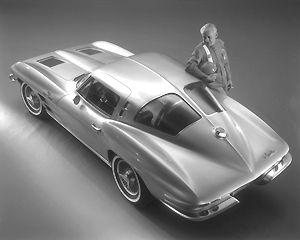
The first-ever production Corvette coupe, a futuristic fastback, sported an unusual styling element for its time period - a divided rear window. The rear window's basic shape had been originally conceived by Bob McLean for the Q-model. The rest of the Sting Ray design was equally stunning. Quad headlamps were retained but newly hidden - the first American car so equipped since the 1942 DeSoto. The lamps were mounted in rotating sections that matched the sharp-edged front end with the "eyes" closed. The Corvette continued to use hidden headlamps until the C6 model debuted in 2005. Coupe doors were cut into the roof, which made entry/exit easier in such a low-slung closed car. Faux vents were located in the hood and on the coupe's rear pillars; functional ones had been intended but were cancelled due to cost considerations. The fastback design was later adopted by another GM car, the third-generation Buick Riviera that debuted in 1971, with the "Boattail" nickname applied to the larger Buick design.
The Sting Ray's interior carried a new interpretation of the twin-cowl Corvette dash motif used since 1958, It was also more practical, now incorporating a roomy glovebox, an improved heater, and the cowl-ventilation system. A full set of round gauges included a huge speedometer andtachometer. The control tower center console returned, somewhat slimmer but now containing the clock and a vertically situated radio. Luggage space was improved as well, though due to a lack of an external trunklid, cargo had to be loaded behind the seats. The spare tire was located at the rear in a drop-down fiberglass housing beneath the gas tank (which now held 20 gallons instead of 16). The big, round deck emblem was newly hinged to double as a fuel-filler flap, replacing the previous left-flank door.
Though not as obvious as the car's radical styling, the new chassis was just as important to the Sting Ray's success. Maneuverability was improved thanks to the faster recirculating ball, or "Ball-Race", steering, and a shorter wheelbase. The latter might ordinarily imply a choppier ride, but the altered weight distribution partly compensated for it. Less weight on the front wheels also meant easier steering, and with some 80 additional pounds on the rear wheels, the Sting Ray offered improved traction. Stopping power improved, too. Four-wheel cast-iron 11-inch drum brakes remained standard but were now wider, for an increase in effective braking area. Sintered-metallic linings, segmented for cooling, were again optional. So were finned aluminum drums, which not only provided faster heat dissipation (and thus better fade resistance) but less unsprung weight. Power assist was available with both brake packages. Evolutionary engineering changes included positive crankcase ventilation, a smaller flywheel, and an aluminum clutch housing. A more efficient alternator replaced the old-fashioned generator.
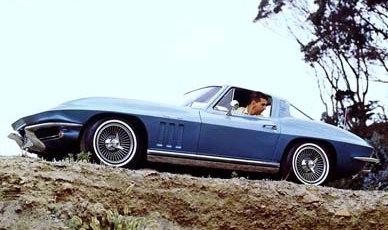 rive trains were carried over from the previous generation, comprising four small block 327 V8s, three transmissions, and six axle ratios. Carbureted engines came in 250, 300, and 340-horsepower versions. As before, the base and optional units employed hydraulic lifters, a mild camshaft, forged-steel crankshaft, 10.5:1 compression, single-point distributor, and dual exhausts. The 300-bhp engine produced its extra power via a larger four-barrel carburetor (Carter AFB instead of the 250's Carter WCFB), plus larger intake valves and exhaust manifold. Again topping the performance chart was a 360-bhp fuel-injected V8, available for an extra $430.40. The car's standard transmission remained the familiar three-speed manual, though the preferred gearbox continued to be the Borg-Warner manual four-speed, delivered with wide-ratio gears when teamed with the base and 300-bhp engines, and close-ratio gearing with the top two power plants. Standard axle ratio for the three-speed manual or Power glide automatic was 3.36:1. The four-speed gearbox came with a 3.70:1 final drive, but 3.08:1, 3.55:1, 4.11:1, and 4.56:1 gear sets were available. The last was quite rare in production, however.
Corvette's designers and engineers - Ed Cole, Zora Arkus-Duntov, Bill Mitchell, and others knew that after 10 years in its basic form, albeit much improved, it was time to move on. By decade's end, the machinery would be put into motion to fashion a fitting successor to debut for the 1963 model year. After years of tinkering with the basic package, Bill Mitchell and his crew would finally break the mold of Harley Earl's original design once and for all. He would dub the Corvette’s second generation "Sting Ray" after the earlier race car of the same name. The C2 was designed by Larry Shinoda under the direction of GM chief stylist Bill Mitchell. Inspiration was drawn from several sources: the contemporary Jaguar E-Type, one of which Mitchell owned and enjoyed driving frequently; the radical Sting Ray Racer Mitchell designed in 1959 as Chevrolet no longer participated in factory racing; and a Mako shark Mitchell caught while deep-sea fishing. Zora Arkus-Duntov ("father of the Corvette") disliked the split rear window (which also raised safety concerns due to reduced visibility) and it was discontinued in 1964, as were the fake hood vents.
The Sting Ray was lauded in the automotive press almost unanimously for its handling, road adhesion, and sheer power.
Car Life magazine bestowed its annual Award for Engineering Excellence on the 1963 Sting Ray. Chevy's small-block V-8 - the most consistent component of past Corvette performance was rated by the buff books to be even better in the Sting Ray. The 1963 was noted to have an edge over past models in both traction and handling because the new independent rear suspension reduced wheel spin compared to the live-axle cars.
Motor Trend tested a four-speed fuel injected version with 3.70:1 axle. They reported a 0-60 mph in 5.8 seconds and a 14.5-second standing quarter-mile at 102 mph. The magazine also recorded better than 18 miles per gallon at legal highway speeds and 14.1 mpg overall.
Motor Trend timed a 1964 fuel-injected four-speed coupe with the 4.11:1 rear axle, aluminum knock-off wheels (perfected at last and available from the factory), the sintered-metallic brakes, and Positraction through the quarter-mile in 14.2 seconds at 100 mph and the 0 to 60 mph in 5.6 seconds.
Road & Track tested the 300-bhp Power glide automatic setup in a '64 coupe and recorded a 0-60-mph time of 8.0 seconds, a quarter-mile in 15.2 seconds at 85 mph, and average fuel consumption of 14.8 mpg.
In 2004, Sports Car International named the Sting Ray number five on the list of Top Sports Cars of the 1960s.
Source:Wikipedia

0 comments