DeLorean DMC-12

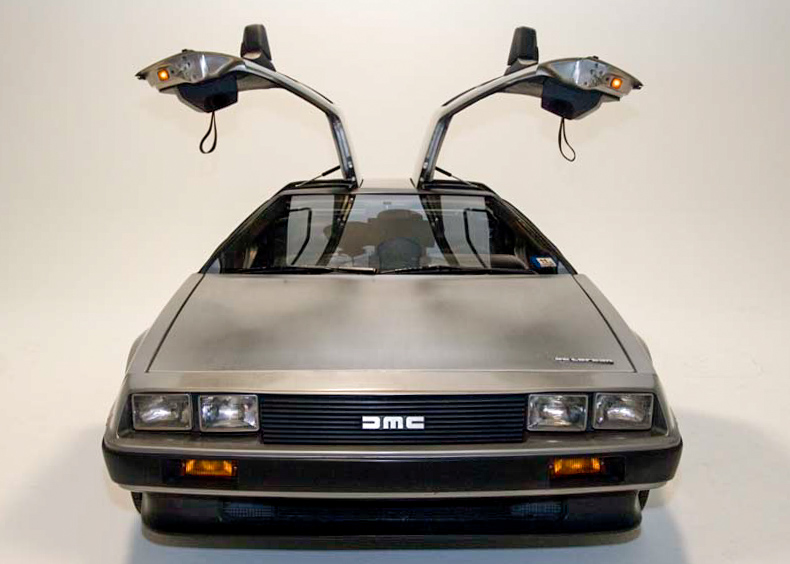
.jpg) Despite what you remember about the DeLorean from the Back to the Future movies, it was only fast if you dropped it off a cliff, but it is certainly hard to forget. Stainless steel body, gullwing doors and a body flat enough to grill on, the DMC-12 is one seriously beautiful failure. Its founder and creator was a crook, but he put his stamp on the automotive world by bringing us a vehicle that was like nothing else. Flux capacitor optional.
Despite what you remember about the DeLorean from the Back to the Future movies, it was only fast if you dropped it off a cliff, but it is certainly hard to forget. Stainless steel body, gullwing doors and a body flat enough to grill on, the DMC-12 is one seriously beautiful failure. Its founder and creator was a crook, but he put his stamp on the automotive world by bringing us a vehicle that was like nothing else. Flux capacitor optional.
The DeLorean DMC-12 (commonly referred to simply as the DeLorean as it was the only model ever produced by the company) is a sports car manufactured by John DeLorean's DeLorean Motor Company for the American market from 1981–83. The car features gull-wing doors and an innovative fiberglass chassis and under-body structure, along with a brushed stainless steel body. The car became widely known and iconic for its appearance and was modified as a time machine in the Back to the Future film trilogy.
The first prototype appeared in October 1976. Production officially began in 1981 in Dunmurry, a suburb of southwest Belfast, Northern Ireland, where the first DMC-12 rolled off the production line on January 21. Over the course of production, several features of the car were changed, such as the hood style, wheels and interior. About 9,000 DMC-12s were made before production halted in early 1983.
The DMC-12 was the only model produced by the company, which was later liquidated as the US car market went through its largest slump since the 1930s. In 2007, about 6,500 DeLorean Motor cars were believed still to exist.
British entrepreneur Stephen Wynne, based in Texas, started a separate company in 1995 using the "DeLorean Motor Company" name and shortly thereafter acquired the trademark on the stylized "DMC" logo as well as the remaining parts inventory of the original DeLorean Motor Company. The company, at its suburban Humble, Texas, location, builds new cars from new old stock(NOS) parts, original equipment manufacturer (OEM) and reproduction parts on a "made to order" basis using existing vehicle identification number (VIN) plates.
On January 27, 2016, the new DMC announced that it would build 300 DMC-12 cars in late 2016 and "new" DMC-12s in early 2017, each projected to cost just under $100,000.
 In October 1976, the first prototype DeLorean DMC-12 was completed by American automotive chief engineer William T. Collins, formerly chief engineer at Pontiac. Originally, the car was intended to have a centrally-mounted Wankel rotary engine. The engine selection was reconsidered when Comotor production ended, and the favored engine became Ford's "Cologne V6." Eventually the French/Swedish PRV(Peugeot-Renault-Volvo) fuel injected V6 was selected. Also the engine location moved from the mid-engined location in the prototype to a rear-engined installation in the production car. The chassis was initially planned to be produced from a new and untested manufacturing technology known as elastic reservoir molding (ERM), which would lighten the car while presumably lowering its production costs. This new technology, for which DeLorean had purchased patent rights, was eventually found to be unsuitable.
These and other changes to the original concept led to considerable schedule pressures. The entire car was deemed to require almost complete re-engineering, which was turned over to engineer Colin Chapman, founder and owner of Lotus Cars. Chapman replaced most of the unproven material and manufacturing techniques with those then employed by Lotus.
In an interview with James Espey of the new incarnation of the DeLorean Motor Company of Texas, a drawing surfaced showing that the car was potentially to be called Z Tavio. John DeLorean's middle name and his son's first name were both Zachary while Tavio was his father's name and his son's middle name. Due to only sporadic documentation, there is little more that is currently known about the Z Tavio name and why it was ultimately rejected in favor of the DMC-12.
DeLorean required $175 million to develop and build the motor company. Convincing Hollywood celebrities such as Johnny Carson and Sammy Davis, Jr. to invest in the firm, DeLorean eventually built the DMC-12 in a factory in Dunmurry, Northern Ireland, a neighborhood a few miles from Belfast city center.
The company had originally intended to build the factory in Puerto Rico but changed its plans when the Northern Ireland Development Agency offered £100 million towards it, despite an assessment by consultants hired by the NIDA that the business had only a 1-in-10 chance of success.
Construction on the factory began in October 1978, and although production of the DMC-12 was scheduled to start in 1979, engineering problems and budget overruns delayed production until early 1981.
By that time, the unemployment rate was high in Northern Ireland and local residents lined up to apply for jobs at the factory. The workers were largely inexperienced, but were paid premium wages and supplied with the best equipment available. Most quality issues were solved by 1982 and the cars were sold from dealers with a one-year, 12,000-mile (19,000 km) warranty and an available five-year, 50,000-mile (80,000 km) service contract.
The body design of the DMC-12 was a product of Giorgetto Giugiaro of Ital Design and is panelled in brushed SS304 stainless steel. Except for three cars plated in 24-carat gold, all DMC-12s left the factory uncovered by paint or clear-coat. Painted DeLoreans do exist, although these were all painted after the cars were purchased from the factory. Several hundred DMCs were produced without stainless panels, for training workers, and are referred to as "black cars" or "mules", in reference to their black fiberglass panels instead of stainless, though these were never marketed. Small scratches in the stainless steel body panels can be removed with a non-metallic scouring pad (since metal pads can leave iron particles embedded in the stainless steel which can give the appearance of the stainless "rusting"), or even sandpaper. The stainless steel panels are fixed to a fiberglass, monocoque under-body. The under-body is affixed to a double-Y frame chassis, derived from the Lotus Esprit platform.
The unpainted stainless body creates challenges during restoration of the cars. In traditional automotive body repair, the panel is repaired to be as original ("straight") as possible and imperfections are sculpted back to form with body filler like Bondo or lead (body solder). This poses no problem (aside from originality) with most cars, as the filler will be hidden by the car's paint (for example, most new cars have filler hiding the seam where the roof meets the quarter panel). With an unpainted stainless body, the stainless steel must be reworked to exactly the original shape, contour, and grain—which is a tremendously difficult job on regular steel (a dented or bent panel is stretched and a shrinking hammer or other techniques must be used to unstretch the metal) and even more difficult with stainless due to its tendency to work-harden. Furthermore, it is exceedingly difficult to paint stainless steel due to difficulties with paint adhesion. DeLorean envisioned that damaged panels would simply be replaced rather than repaired; each DeLorean service center today has at least one experienced body repair person on staff, and there are decades worth of new stainless panels still available in most instances.

Another unusual feature of the DMC-12 is its gull-wing doors. The common problem of supporting the weight of gull-wing doors was solved by other manufacturers with lightweight doors in the Mercedes-Benz 300SL and a hydraulic pump in the Bricklin SV-1, although these designs had structural or convenience disadvantages. The DMC-12 features heavy doors supported by cryogenically preset torsion bars and gas-charged struts. These torsion bars were developed by Grumman Aerospace (and built by Unbrako in the UK, a division of SPS Technologies of Jenkintown, PA) to withstand the stresses of supporting the doors. A popular misconception of the DMC-12's gull-wing doors is that they require far more side clearance to open relative to ordinary side-hinge doors, such as when parked in a parking lot. In fact, the opposite is true: the DMC-12 requires far less clearance than side-hinge doors, and this can be physically demonstrated. This misconception of side clearance may stem from a misunderstood location of the hinge point of the doors by persons unfamiliar with DMC-12s. These doors, when opening, only require 11 inches (28 cm) clearance outside the line of the car, making opening and closing the doors in crowded spaces relatively easy. Much like the doors fitted to the Lamborghini Countach, the DMC-12 doors featured small cutout windows, because full-sized windows would not be fully retractable within the short door panels. Additionally, the doors featured red and amber "safety" lights around the perimeter. These lights illuminated when the door was open and could be seen from the front, rear or side of the vehicle at night or low light situations.
The engine is a Peugeot-Renault-Volvo (PRV) 2.85 liter V6 which was designed and built under special contract with the DMC Company. These PRV engines were a development of the 2.7 litre V6 in the Renault 30, and were built in the PRV Factory in Douvrin, Northern France. The gearbox, also designed by PRV, was built at the Renault facility nearCaen in Normandy. The engines and gearboxes were shipped weekly by sea from the PRV Factories to the DMC Factory in Dunmurry, Northern Ireland.
The car was named the DMC-12 because of its intended original price of US$12,000. In 1981, a DMC-12 had a suggested retail price of $25,000 ($650 more when equipped with an automatic transmission); this is equivalent to approximately $65,071 in 2015. There were extensive waiting lists of people willing to pay up to $10,000 above the list price; however, after the collapse of the DeLorean Motor Company, unsold cars could be purchased for less than the retail price.
The DMC-12 was only available with two factory options; a no-cost manual transmission or automatic transmission ($650 extra) and the choice of a grey or black interior. Several dealer options were available, including a car cover; floor mats; black textured accent stripes; grey scotch-cal accent stripes; a luggage rack and a ski-rack adapter. The standard feature list included stainless steel body panels; gull-wing doors with cryogenically treated torsion bars; leather seats; air conditioning; an AM/FM cassette stereo system; power windows,locks and mirrors; a tilt and telescopic steering wheel; tinted glass; body side moldings; intermittent/constant windshield wipers; and an electric rear window defogger.
Source:Wikipedia

0 comments